Authors:
Lucas Costa, Latin American Reserve Fund – FLAR, Bogotá, Colombia. Email: – lcosta@flar.net
Carlos Giraldo, Latin American Reserve Fund – FLAR, Bogotá, Colombia. Email: – cgiraldo@flar.net
Iader Giraldo-Salazar, Latin American Reserve Fund – FLAR, Bogotá, Colombia. Email: – igiraldo@flar.net
The reorientation of trade, finance, and technology according to geopolitical affinity (geoeconomic fragmentation or geofragmentation) is already reducing bilateral trade, especially between rival blocs. In our recent working paper, Is Geoeconomic Fragmentation that Bad? Measuring its Impacts on Bilateral Trade, we constructed a multidimensional index of geofragmentation and used it to measure its effect on global trade flows. We found that fragmentation does not break global trade, but rather redirects it. Countries not aligned with either major power increase their trade with both blocs and act as connectors that partially reduce decoupling, a role that, as a region, Latin America could play.
During the decades after the Cold War, globalization drove unprecedented economic integration based on efficiency and comparative advantage. Today, US-China trade disputes, Brexit, the fallout from Russia’s invasion of Ukraine, and the conflict in the Middle East have called that trajectory into question. In a previous FLARblog (See blog), we showed that Latin America’s trade and investment have so far not seen disruptive changes, although the landscape could change rapidly. This new study goes a step further and measures fragmentation while analyzing how it has been reshaping global trade.
Trade policy has traditionally been analyzed through comparative advantage, market size, and distance. However, a different force is reshaping the architecture of global trade: the orientation of trade flows according to geopolitical affinity. Although considerable research has examined geopolitical risk and uncertainty in trade policy separately, few studies combine a comprehensive measure of fragmentation with empirical evidence of its trade effects across a broad set of countries. Previous work tends to focus on individual episodes, specific regions, or a narrow set of indicators, such as geopolitical risk, Iacoviello et al., (2024), one-off events such as the war in Ukraine, or the onset of a new Cold War, Gopinath et al., (2025). Our starting point is different; fragmentation does not act through a single channel. It simultaneously reconfigures investment decisions, migration and knowledge flows, and diplomatic alignments. Thus, any measure that ignores this multidimensionality will not adequately capture this phenomenon.
For this reason, in our study we combined sixteen indicators grouped into commercial, financial, mobility and political factors, and aggregated them using a dynamic factor model to create a global indicator of geofragmentation since 2000. The results show how geofragmentation has increased steadily since the global financial crisis and is now at levels comparable to those observed after the attacks of September 11, 2001 (Figure 1).
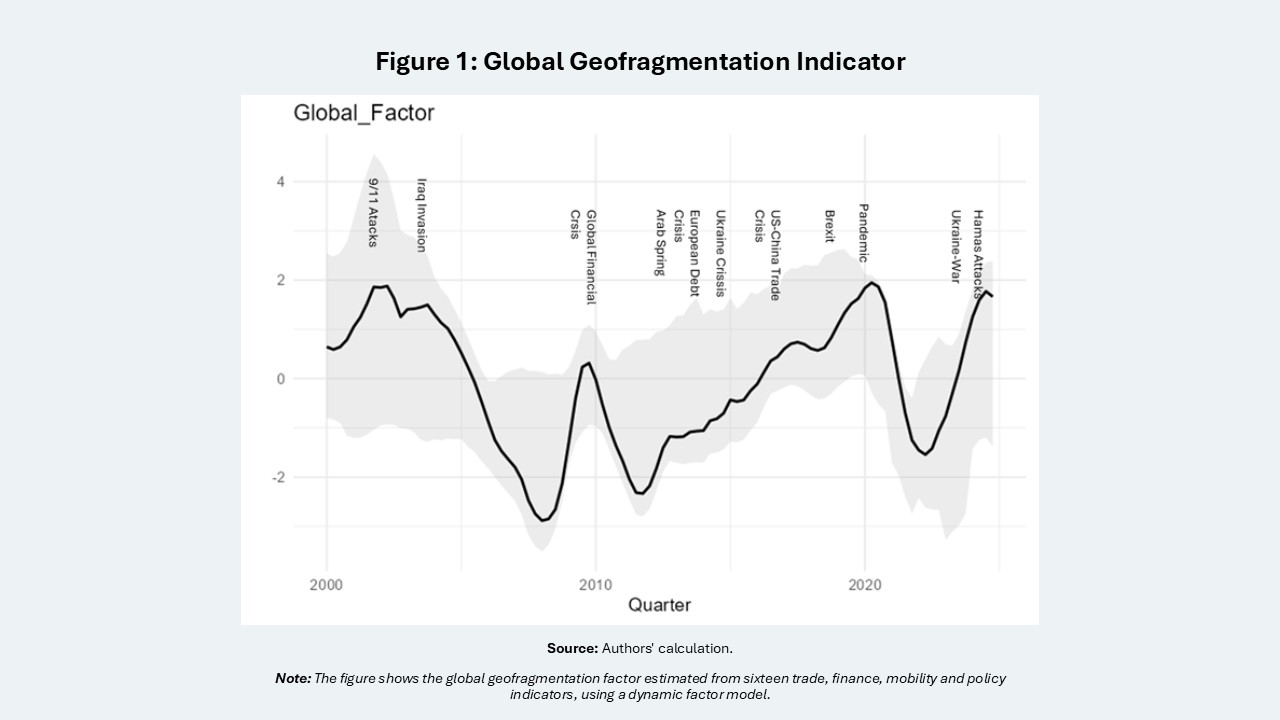

The results show that geofragmentation significantly reduces bilateral trade, even after controlling for the usual determinants of trade. The decline is greater between geopolitically distant partners and between countries in different blocs, while trade within the bloc of advanced economies aligned with the US tends to increase.
Non-aligned countries show a different pattern. Rather than suffering the same contraction, during episodes of high fragmentation they increase their trade with distant blocs, while trade between countries belonging to this bloc declines, which is consistent with the role of intermediaries channeling flows that would otherwise be blocked. This intermediation fails to fully counteract the negative effects of geofragmentation, but it can act as a buffer. It is also a partial and non-uniform effect across groups of countries.
What does this mean for Latin America? As a region, Latin America is classified as non-aligned according to the methodology we use. If that position holds, the region could play the role of connector and capture trade and investment that would previously have flowed directly between the US- and China-led blocs. However, the opportunity is not automatic. It depends on the region developing the logistics, infrastructure, and productive capacity needed to absorb those flows, and on the major powers not closing the indirect channels that sustain trade between blocs today. How trade and supply chains are reorganized will have an impact on the external revenues, financing, and macroeconomic stability of the countries in the region.
These findings reveal a story that goes beyond a simple narrative of decoupling. Fragmentation is unlikely to produce a total collapse of global trade; rather, it is reorganizing supply chains between the two major blocs, with neutral countries emerging as potential connectors. For advanced economies and members of the two major blocs, this implies a gradual loss of the efficiency gains associated with unconstrained global sourcing. Questions remain: how durable the connector role of nonaligned economies will be if tensions escalate, and whether their gains will translate into structural improvement or be just a transitory opportunity. Future research that extends the index to higher-frequency data or links it to firm-level decisions could shed light on how these patterns evolve.
References
Bailey, M. A., Strezhnev, A., & Voeten, E. (2017). Estimating dynamic state preferences from United Nations voting data. Journal of Conflict Resolution, 61(2), 430–456. https://doi.org/10.1177/0022002715595700
Gopinath, G., Gourinchas, P.-O., Presbitero, A. F., & Topalova, P. (2025). Changing global linkages: A new Cold War? Journal of International Economics, 153, 104042.
Iacoviello, M., Caldara, D., Penn, M., & Conlisk, S. (2024). Do geopolitical risks raise or lower inflation? SSRN. https://doi.org/10.2139/ssrn.4852461