Authors:
Carlos Giraldo, Latin American Reserve Fund, Bogotá, Colombia. Email: – cgiraldo@flar.net
Iader Giraldo, Latin American Reserve Fund, Bogotá, Colombia. Email: – igiraldo@flar.net
Jose E. Gomez-Gonzalez, Department of Finance, Information Systems, and Economics, City University of New York – Lehman College, Bronx, NY, 10468, USA. Email: – jose.gomezgonzalez@lehman.cuny.edu
Jorge M. Uribe, Faculty of Economics and Business, Universitat Oberta de Catalunya, Barcelona, Spain, Email: – jorge.uribe@ub.edu
Geopolitical tensions have become an increasingly important source of economic and financial uncertainty. Events such as the Russia–Ukraine war, tensions between the United States and China, trade disputes, sanctions, and regional conflicts have intensified concerns about the resilience of financial systems, particularly in emerging economies, where banks play a central role in financial intermediation and remain heavily dependent on domestic funding conditions. Our recent research shows that these shocks reach banks from both sides of the balance sheet: geopolitical risk not only curbs bank lending, as prior work has documented, but also significantly reduces deposit growth, weakening the funding base that emerging-market banks rely on to sustain credit.
A growing body of literature is examining how geopolitical risk affects financial markets and banking activity. Recent studies show that geopolitical risk increases systemic risk and weakens bank stability, reduces cross-border lending and shapes the international activity of banks, and raises financial stress while curbing credit growth, as documented for European banks following the Russian invasion of Ukraine. The existing studies, however, have focused mainly on the asset side of banks’ balance sheets, particularly lending activity, risk-taking behavior, or market-based measures of financial vulnerability.
Much less attention has been given to understanding whether geopolitical shocks also affect banks’ funding conditions. A recent exception finds that geopolitical risk actually increases aggregate bank deposits in European countries, consistent with a flight-to-safety response by depositors. Whether a similar dynamic holds in emerging markets, where banks rely much more heavily on customer deposits as their main source of funding, remains an open question. If, instead, geopolitical tensions weaken depositor confidence or reduce funding stability in these economies, banks may face constraints in their ability to sustain credit growth. This would operate through a mechanism resembling the traditional bank lending channel discussed in the monetary policy literature: reductions in deposits constrain banks’ ability to extend loans, particularly for institutions that cannot easily replace lost funding through financial markets. A comparable mechanism may emerge during periods of geopolitical stress if deposit growth weakens and banks become more cautious in their lending decisions.
In our recent paper, Geopolitical Risk and Banking Activity: An Asset–Liability Perspective, we studied how geopolitical risk affects both sides of banks’ balance sheets in emerging economies. Using an unbalanced panel of 1,281 banks across 21 emerging countries between 2011 and 2021, we examine whether geopolitical shocks influence not only customer loan growth but also deposit growth. The analysis combines bank-level information from BankFocus with the country-specific geopolitical risk index developed by Caldara and Iacoviello (2022). Our empirical approach relies on two-way fixed-effects panel regressions that control for macroeconomic conditions, bank-specific characteristics, and ownership structure.
The results show that geopolitical risk has a negative and economically meaningful effect on both lending growth and deposit growth. Consistent with the existing literature, we find that increases in geopolitical risk reduce bank lending activity. More importantly, we also find that geopolitical shocks significantly reduce deposit growth. This result is central to the contribution of the paper because it suggests that geopolitical shocks affect banking systems not only through higher uncertainty or weaker economic conditions but also through disruptions in banks’ funding capacity.
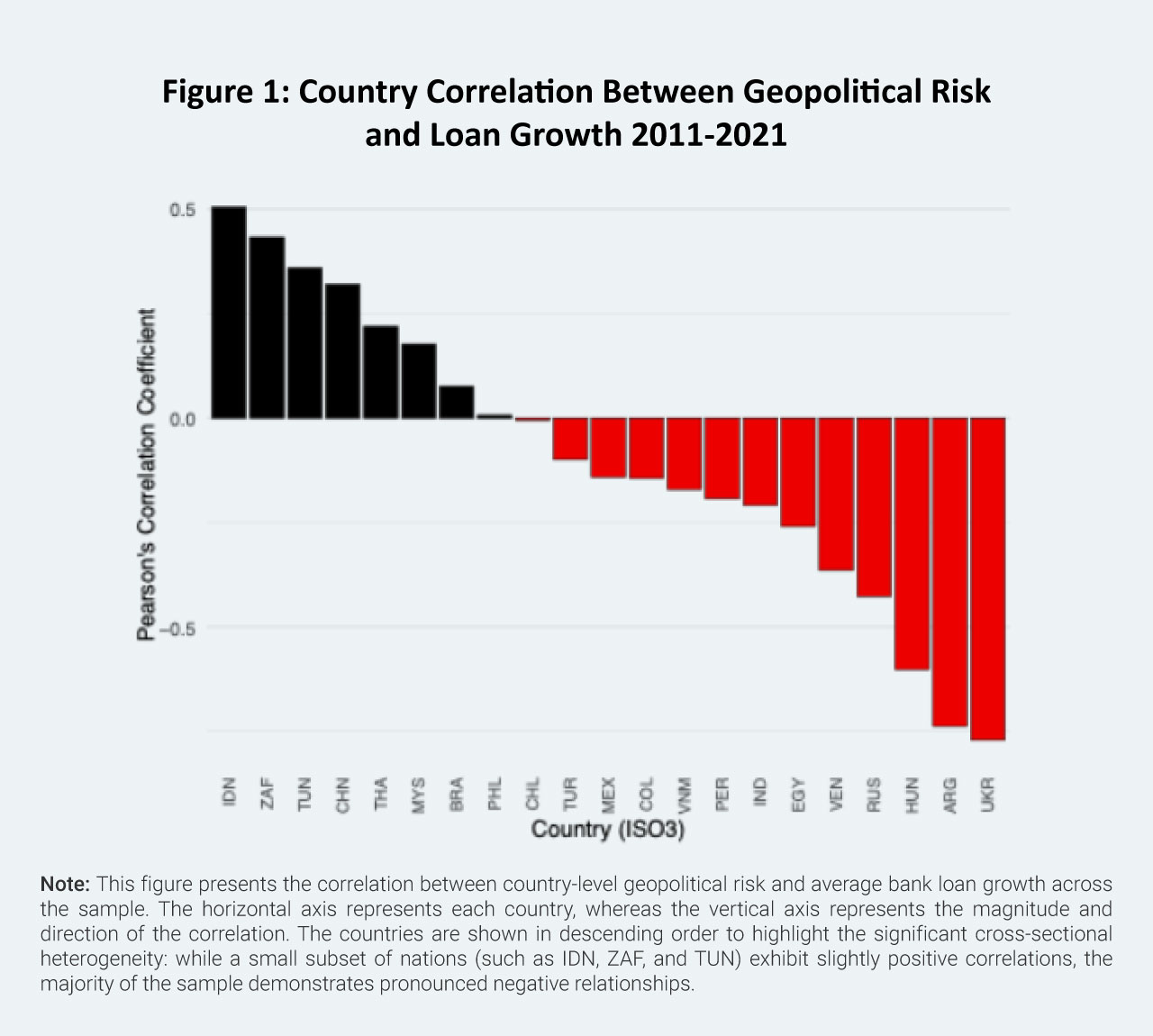
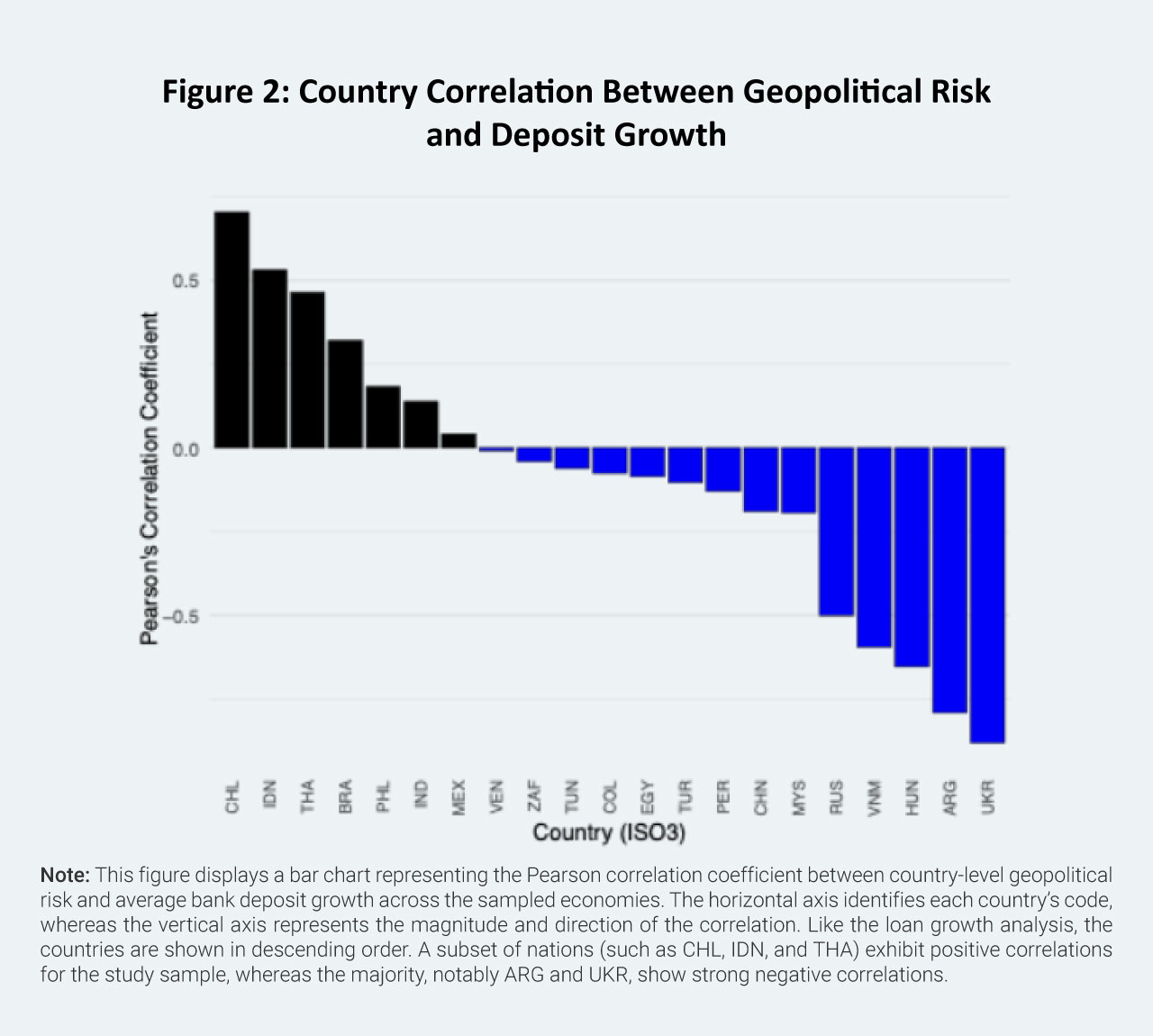
The simultaneous decline in deposits and lending provides evidence consistent with a balance-sheet transmission mechanism. In emerging economies, where banks depend strongly on deposit financing, weaker deposit growth can directly limit the supply of loans. Banks that are unable to quickly substitute lost deposits with wholesale or international funding may respond by reducing credit expansion, increasing liquidity buffers, or tightening lending standards. The results for foreign-owned banks support this interpretation. We find that foreign-owned institutions are less negatively affected by geopolitical shocks in their lending activity, suggesting that access to alternative funding sources or support from parent institutions may partially shield these banks from domestic funding pressures.
Our study also documents important differences across regions and over time. The negative impact of geopolitical risk on lending is stronger in Sub-Saharan Africa, whereas deposit growth in MENA economies appears relatively more resilient to geopolitical tensions. In addition, the results of the dynamic analysis reveal that the effects of geopolitical shocks persist for several years, indicating that these disturbances generate longer-lasting consequences for financial intermediation rather than temporary disruptions.
These findings have several policy implications. First, they highlight the importance of treating geopolitical risk as a source of financial vulnerability, especially in emerging economies where banking systems rely strongly on deposit funding. Policymakers and regulators should recognize that geopolitical shocks can simultaneously weaken bank funding and reduce credit supply, amplifying the impact on economic activity.
Second, the results underline the importance of strong liquidity positions and stable funding structures within the banking sector. Regulatory frameworks that encourage prudent liquidity management and reduce excessive dependence on unstable funding sources may help banks absorb periods of geopolitical stress more effectively.
Third, the findings suggest that developing deeper and more diversified financial markets could strengthen the resilience of emerging banking systems. Banks with better access to alternative funding channels may be more capable of maintaining lending activity when deposit growth weakens during geopolitical crises.
More broadly, the results suggest that geopolitical tensions should no longer be viewed only as external political events with indirect economic consequences. They also represent an important source of financial instability that can affect the core functioning of banking systems. As geopolitical uncertainty becomes a more persistent feature of the global economy, understanding its effects on bank funding and credit activity will remain increasingly important for both policymakers and researchers.
References
Caldara, D., & Iacoviello, M. (2022). Measuring geopolitical risk. American Economic Review, 112(4), 1194–1225.